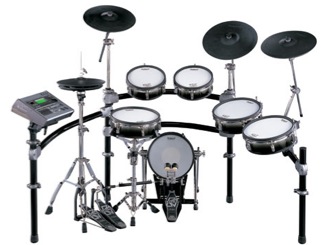
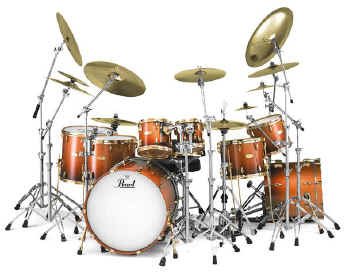
Monday... The Pearl Roadshow drum kits are the perfect answer to the beginning drummer's question of: "What drums should I buy to practice what I've been learning in lessons?". I'm so glad Pearl has put this together, it makes my life much easier. The kits come in popular configurations, with popular color choices, and include everything a student drummer needs: drums, cymbals, hardware, throne, sticks, and even a stick bag. Local News: Check this out! Steve Gadd performed at a local Italian restaurant/bar called Voce, unfortunately the venue is no longer in business, but the show was amazing (of course) and it's available for download or on CD. Tuesday... A person could spend a lifetime studying the intricacies and mysteries of drum set, but it's still important to understand other instruments. A working knowledge of music theory and an ability to play other instruments can vastly improve your drumming and the contributions you make to the music your band produces and performs. Besides improving your creativity, there are financial motivations and considerations... songwriters in a band generally get paid more! Do you know anyone who has ever written a song on the drums? Learning to read and write music (even drum music) will go a long way towards developing your knowledge of music theory. While it may be true you don't "need" to know how to read music to play music, Peter Erskine's philosophy is, "Why promote illiteracy?". The act of writing out music helps in assimilating new ideas, helps communicate your ideas to other musicians, and helps you remember them for later reference. Besides drums, I also play guitar and bass. These abilities have helped me in band settings, and in lessons with my students, by making rehearsals, performances and lessons a lot more fun and productive. I don't force reading or playing another instrument on my students, but even the students that are most reluctant to learn to read soon recognize the benefits, and a lot of my students decide they want me to teach them guitar as well. Wednesday... The Drummer's Den has the Easton Ahead "workout" drumsticks in stock. These Ahead sticks are heavier than normal sticks and are intended for use on practice pads, to strengthen your grip, your wrist muscles, and even your arms. I used some of these workout sticks, and they're great! After using them, I picked up some regular sticks and it felt like I had significantly more control. Come to The Drummer's Den for drum lessons in Scottsdale and for Ahead workout drum sticks. Monday... Ever dreamt of getting a gig playing drums on a cruise ship? Ship drummers usually work in one of four band settings: show band, dance band, jazz trio or calypso band. Out of the four, a show band drummer is typically the only seat that a drummer can fill on his own. The other bands usually get the gig as a unit, they're a band that's already been playing together before getting booked on a cruise. So if you're not in an established band, that wants to play on cruises, then your best bet is to apply as a show drummer. Show drummers need sight-reading skills and the ability to play many different styles of music. Come to The Drummer's Den to work on your sight-reading and develop your versatility. Tuesday... Paul Shaffer, the band leader for David Letterman's show, wrote a book: "We'll Be Here for the Rest of Our Lives: A Swingin' Showbiz Saga". Paul began his musical journey at a very young age playing bongos at family "beatnik" parties. Paul moved on to the drumset, and is now a master of the Hammond B-3 organ. In a recent interview, Paul talked about what it takes to fill the drum throne on the Letterman show. He said, "you have to know a bunch of songs in every style - jazz, blues, R&B, rock..." and the drummer has to have "the kind of time where (the rest of the band) always knows where it's going to be. You don't want a guy who comes out of a fill and you're not sure where the downbeat is. You'd be surprised how many professional drummers are like that." Paul went on to say that great drummers make you want to dance, "...rock and roll is all about making people dance. So that's the function of the drummer right there. And the way to do that is to play something that feels good - and the way to make it feel good is basically to play it in time." Great points Paul! Do you want to make your drumming feel good? Want to make people dance? Want to develop your time and come out of fills on the downbeat? Come to The Drummer's Den for lessons, I can help you get there! Wednesday... "It Might Get Loud" is a documentary that explores the history of the electric guitar by focusing on Jimmy Page (Led Zep), Jack White (White Stripes) and The Edge (U2). The highlight of the film is when these three giants in the world of guitar players, come together to talk about their influences and techniques, play each other's songs, and then jam on a rock classic from The Band, "The Weight". So I'm wondering, what would the drum version of this documentary be like? You'd need a modern cutting edge drummer, maybe Travis Barker? Danny Carey? to fill Jack White's role, a pop rock drummer from the 80s, 90s, and 2Ks, I suppose Larry Mullen Jr. from U2 would be an obvious choice, and a drum god best known for their work in the 60s and 70s, unfortunately there's no way to get John Bonham or Mitch Mitchell, Neil Peart doesn't quite fit the bill, but that would be cool, Billy Ward - Black Sabbath? Charlie Watts - Rolling Stones? Ringo - Beatles? Personally, I'd like to see a meeting of Stewart Copeland - Police, Dave Grohl - Nirvana and Chad Smith - Red Hot Chili Peppers and maybe an Alex Van Halen or a Tommy Lee! Or how about Steve Gadd, Kenny Aronoff, and Josh Freese... Thursday... If you're like me you'd agree, you can never have too many cymbals. Some drummers are brand loyal. I don't know why. My guess is, that probably most drummers see the pro only playing one brand of cymbal and they figure, that's how it's done. But the touring pros only play one brand because they get paid to play one brand, and they get their cymbals for free. The rest of us don't need to play one certain brand, we need to play the cymbals that have the sounds that are right for the music that we're playing, that have the sounds that we want to hear. I'm not trying to say that a drummer is somehow superior to any other drummer just because they personally own cymbals from five different cymbals manufacturers, I'm just saying that I don't subscribe to the "one brand only" philosophy, and I don't think anyone else needs to feel locked into brand loyalty, unless they have a contract with that maker. I suggest you buy the cymbal based on the sound you get out of it, not the name that's stamped on it. Well.. enough about that, now for a few interesting tid bits about one cymbal maker, Sabian. You might not know this, but Sabian was established by Robert Zildjian. Yes, a member of the Zildjian family actually established Sabian. Robert split from the Zildjian company in 1980 and started the Sabian cymbal company in Canada. The name Sabian is actually a combination of the names of Robert's children: SAlly, BIlly, and ANdy. Sabian's website is one of the three most visited sites for drums in the world, check'em out Sabian Friday... The electronic drum market is growing mostly due to two big reasons, technological advancements and a new generation of drummers that are more open to playing electronic drums. There's an analogy between electronic drums and digital pianos, back in the '80s everyone thought they sounded bad, and fake, but today they are more accepted and they sound great. Some of the reasons that electronics are winning over drummers in a big way are that electronics fill a lot of needs that acoustics can't satisfy. With electronic drums, drummers can play at any time, by putting on headphones, they can hear amazing drum sounds without disturbing family members or, if they live in apartments, without disturbing other tenants. Churches also love electronic drums because of the great sounds and the volume control aspect. Show drummers appreciate the variety of sounds and of course, the volume control. Also, recording studios realize the advantages of the electronic drums. For them, there's a huge savings in time and expense to get a great drum sound. Even other musicians, like guitarist, are getting more and more interested in electronic drums. Not the kits necessarily, but the module features, which they can use for sequencing, or simply finding a groove to jam along to. Come to The Drummer's Den and save $$$, I might be located in Scottsdale, but I don't charge "Scottsdale prices". Monday... Josh Freese is a mighty studio drummer who has worked with so many huge names in music that I'm not about to attempt to list them all, but to name just a few... Sting, Devo, Avril Lavigne, Nine Inch Nails, 3 Doors Down, A Perfect Circle, the Offspring, Chris Cornell (Soundgarden, RATM), the Vandals, Slash, Billy Gibbons (ZZ Top), Kelly Clarkson, Clay Aiken, Rob Zombie, Miley Cyrus, Weezer, Guns & Roses, and the list goes on. As a kid Josh practiced what he calls "the most basic rudiments": double stroke rolls, fives and sevens, paradiddles, flam taps, flamadiddles. He recommends recording yourself playing along to drum machines and pre-recorded music and listening back. And playing with other musicians, "you have to play with people". Tuesday... Russ Miller has a DVD called "Arrival: Behind the Glass". Russ hadn't planned on making it a DVD, he was actually just recording an album with a bunch of guest drummers. He was filming solely for historical purposes, but quickly realized that the footage would be great for other drummers to see how these masters of their craft approach the recording process. Drummers on this DVD/CD set include: Steve Gadd, Steve Smith, Pete Lockett, Akira Jimbo, John "JR" Robinson, Wolfgang Haffner, Jeff Hamilton, Johnny Rabb, Zoro and Rick Marotta. Wednesday... "Pitch-tuning", tuning the drums in your drum set to a certain pitch, is a technique used by drum tech, Jim Vincent, the drum tech for Matt Cameron (Soundgarden, Pearl Jam). Jim tunes Matt's toms, from floor tom to high tom, C, F and A#. He tunes the snare to F#. My question is, what if F# isn't in the key of the song being played? Every snare hit is going to be a note that's out of key, and there are a lot of snare hits in any given song. I'll try to contact Jim and see if I can get an answer... I'll be sure to provide his explanation if/when I get one. Friday... Kenny Aronoff is one of the busiest touring/recording drummers in the business. Kenny first came to people's attention as the drummer for John Cougar, with his "fill of a lifetime" in the song "Jack and Diane". Kenny shares some wisdom about things he's learned about success... 1) The first key to success is hard work. Kenny points out that through hard work, people who are more talented will go further, but people with less talent will still go somewhere. They'll go further than they would if they didn't work at it. 2) The second key is passion. It's one thing to work hard when you're into it, but the passion shows and the passion gets you through, when you're willing to work hard even when things get rough and tough. 3) The third key is education. Constantly learning, educating and re-educating yourself. Keep growing. Thursday... Finished reading Paul Shaffer's "We'll Be Here for the Rest of Our Lives". I recommend it. A couple of the drummers that Paul talks about are the drummers he had at Saturday Night Live, and on The Late Show with David Letterman... Steve Jordan and Anton Fig. Fig took over for Jordan on the Letterman show in 1986. He says the Letterman show never feels like it's "just a job" because it's a different show, with different guests (and different songs) all the time. The band rehearses from 2:50 to 3:10 pm to learn all the cues and comedy bits, then they rehearse with the feature act from 3:15 to 4. At 4:20 they warm up the audience for an hour and then it's show time! Friday... Shawn Pelton is the drummer on Saturday Night Live, since 1993. Shawn plays his acoustic drums for most of the show, but uses a Roland brain for some skits, and some monologues, so that the drums don't bleed into the mics. The SNL schedule is all Saturday, although the musicians are always on call during the week. On Sat, 11am to 1pm they rehearse all the music, before the actors arrive. Around 4:30, they rehearse the opening monologue with the host. Then there's a dinner break followed by a full dress rehearsal, from 8 to 10. Around 11 they warm up the audience, and at 11:30 the show goes live. Monday... Another TV drummer, Ahmir "Questlove" Thompson, the drummer/producer and leader of The Roots, the band Jimmy Fallon. Ahmir says that he has read Malcolm Gladwell's book "Outliers", which is about the science of practice and prepartation. Gladwell takes stories from Micheal Jordan to Bill Gates to The Beatles and points out that all of these people have practiced their craft for at least 10,000 hours. For example, The Beatles, in Hamburg, played eight hours a day every day for 2 and a half years straight. Ahmir still has his Stick Control book from fifth grade. He used to have a practice pad and sticks with him at all times. Tuesday... Some things to consider when thinking about bass drum pedals. The Beater: Size, shape and material all matter. A larger head generally produces more volume and brings out more low-end. A flatter surface produces a bit more attack. A harder material, like wood, acrylic & plastic, also produces more attack. Softer material, like rubber or felt, produces a quieter, rounder sound. Jazz drummers use a soft lamb's wool for a warm tone. The Footboard: most pedals employ a split footboard design, others have a single long footboard a.k.a. "a longboard". Split boards offer more volume and power. Longboards offer a lighter and more responsive action, which is why they're popular with speed metal drummers. Pearl's Demon Drive pedal can be converted from split to long very quickly and easily. The Action Adjustments: Most pedals use a cam, which essentially connects the beater to the pedal board. The shape of the cam makes a big difference in the action of the pedal. A round cam gives a smooth predictable feel, offering more control, especially at lower volumes. Like gears on a bike, a larger round cam will turn more easily and feel lighter than a smaller one. Another common cam shape is the oval, which gives a quicker action and louder note. It requires more effort to get the stroke started but then it seems to accelerate as the stroke progresses. Pearl's Eliminator Pedal offers multiple cams in one pedal. Each cam is shaped differently for a unique feel and is color-coded for easy identification. Pearl's Demon Pedal offers another way to change the feel of the stroke, rather than changing cams, you can change the point on the cam from which the beater is pulled. The Drive Systems: Pedals use a chain, belt or direct drive solid linkage to attach the footboard to the cam. Leather straps were used, but due to wear and breakage, have been replaced by reinforced fiber straps. Chains are durable but tend to have a slightly heavier feel and make more noise than belts/straps. The direct drive design eliminates the slight lag that can occur with a chain or strap drive. The Beater & Footboard Angle Adjustments: The closer the beater is to the head, the quicker it can reach the head, but the closer it is, the less volume and power. Drummers playing quiet acoustic music might want the beater set at a 60 degree angle, loud rock and pop drummers would likely set the beater at a 45 degree angle. Many speed metal drummers set the beater close to the head for speed, and then trigger an aggressive sounding bass drum sample. Drummers who play heel down generally prefer a lower footboard angle because its less tiring for the shin muscles. Heel up players generally use a higher footboard angle.
|
||||